
Breaking the Consensus Trance
Why we need to recognize we're in a collective march to destruction

Waking from the Consensus Trance—Before We Dance Together off the Cliff
Consider a remarkable finding from a survey on domestic violence in India: 45 percent of women reported that a husband was justified in beating his wife for reasons such as neglecting housework or arguing with him. Amazingly, more women than men endorsed the violence committed against them.
This is cultural hegemony at its most visceral — the process by which power maintains itself not through force alone but through the consent it manufactures in the minds of those it oppresses. Antonio Gramsci, writing in Mussolini’s prisons in the 1930s, was the first to name it clearly. He saw how cultural institutions — schools, media, churches — function in the modern era much as moralizing gods did in the ancient world: conditioning people to believe that the system works in their interest, or at least that no alternative exists. When that conditioning succeeds, rulers rarely need to resort to violence. People police themselves.
This mechanism is essential to understand if we want to make sense of one of the defining puzzles of our time: why, as neoliberalism has intensified wealth extraction to levels unseen in modern history, have so many working people turned not against those extracting from them, but toward political movements that promise to accelerate the very processes destroying them? The answer can be found in the astounding effectiveness of a belief system so pervasive it has come to feel like reality itself — what we might call a consensus trance.
The consensus trance of global capitalism is not maintained by any single conspiracy. It is structural, self-reinforcing, and remarkably elegant. A small group of global power elites — no more than seven thousand people, predominantly white, 94 percent male, circulating among Davos, the Bilderberg Group, and the Council on Foreign Relations — own or influence the media channels through which most people encounter the world. The result is what Noam Chomsky and Edward Herman called the manufacture of consent. Even without overt editorial pressure, journalists internalize the filters their outlets require and convince themselves they are providing objective coverage.
The most consequential effect of this trance is that it places the deep structure of the system itself beyond the horizon of serious discussion. The sacred precepts — grow the economy, increase shareholder returns, trust the market — function exactly like religious dogma, enforced by a priesthood of economists, politicians, and analysts as intolerant of heresy as any inquisition.
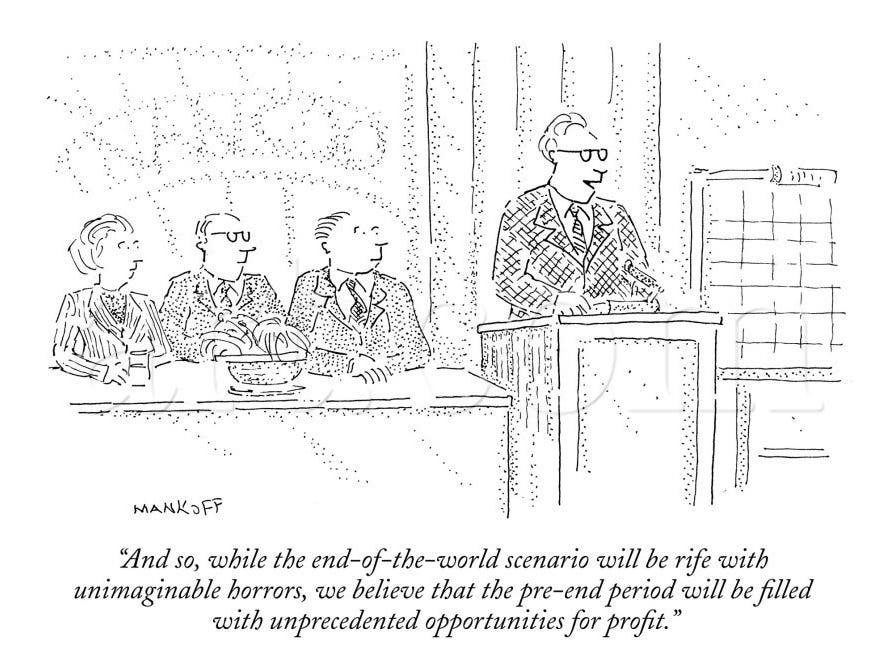
Bob Mankoff, The New Yorker, February 9, 2011
This trance explains why, even when evidence blatantly shows these precepts to be false, they are simply ignored or explained away. In the mid-nineteenth century, economist William Stanley Jevons noticed that improvements to the steam engine, which should logically have reduced coal consumption, instead caused it to soar: cheaper energy per unit simply expanded demand. What became knowns as Jevon’s Paradox has since appeared everywhere, from the cotton gin — which led not to less slavery but dramatically more — to fuel-efficient cars that encouraged people to drive farther.
On closer inspection, however, this is not a paradox at all. It is a defining characteristic of capitalism itself, which I call Windigo’s Law: capital will never cease to exploit any new opportunity that arises in its frenetic quest for greater returns. Efficiency gains are never banked as sufficiency. They become launchpads for further extraction.
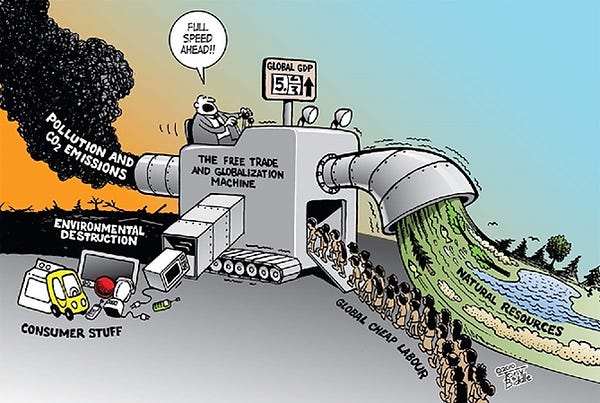
Source: Gary Lauzon / Perfect World Design, Top Ten Reasons CETA is Bad for Canada, Trade Justice Network, 2010
Driven by Windigo’s Law, capital continually seeks new frontiers. Having opened the entire natural world to globalized extraction, Windigo, Inc. has moved on to monetize human social systems — healthcare, education, transportation, prisons — transmuting institutions built to serve human needs into vehicles for capital appreciation. It now colonizes our inner life itself, with smartphone algorithms, enhanced by AI, designed to hack the brain’s reward circuitry, engineering addiction at civilizational scale.
We are collectively marching toward what author Amitav Ghosh calls omnicide — “the desire to destroy everything,” the unrestrainable excess intrinsic to a vision of the world-as-resource. It is Windigo’s omnicidal compulsion that explains how, even as climate breakdown threatens the foundations of human civilization, governments spend over a trillion dollars a year subsidizing the fossil fuel industry, and banks have channeled over three trillion dollars to fossil fuel companies since the Paris Agreement, while the funds needed to protect living ecosystems go almost entirely unraised.
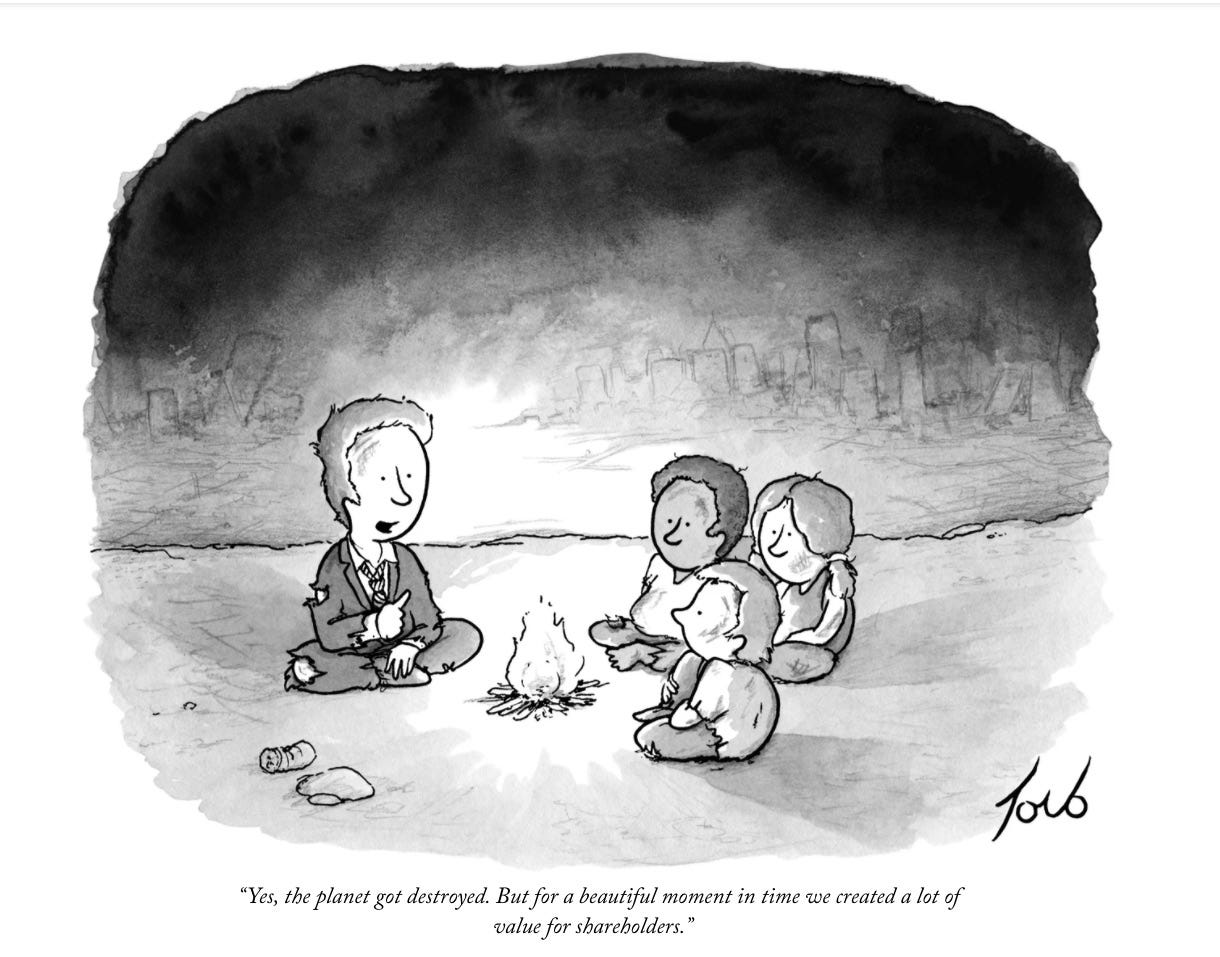
Tom Toro, The New Yorker, November 26, 2012
The Absurdity We’ve Normalized
Once you step outside this consensus trance, it becomes astonishing to realize, not merely that powerful institutions have endorsed a future built on a mirage, but the lengths to which those institutions will go to avoid confronting what the evidence actually shows.
Take the near-universal embrace of “green growth” — the proposition that the economy can expand indefinitely while its ecological impact shrinks. This has been adopted as official policy by the OECD, the World Bank, the European Commission, and enshrined in the UN’s Sustainable Development Goals. One might assume so sweeping a consensus rests on solid empirical foundations. It does not. Rigorous studies confirm that absolute decoupling of economic growth from material throughput has never occurred, and there is no credible evidence it will. Humanity’s material footprint has actually grown faster than GDP over the past two decades — the precise opposite of what green growth requires. Windigo’s Law guarantees it: under capitalism, every efficiency gain becomes an invitation to produce more, not less.
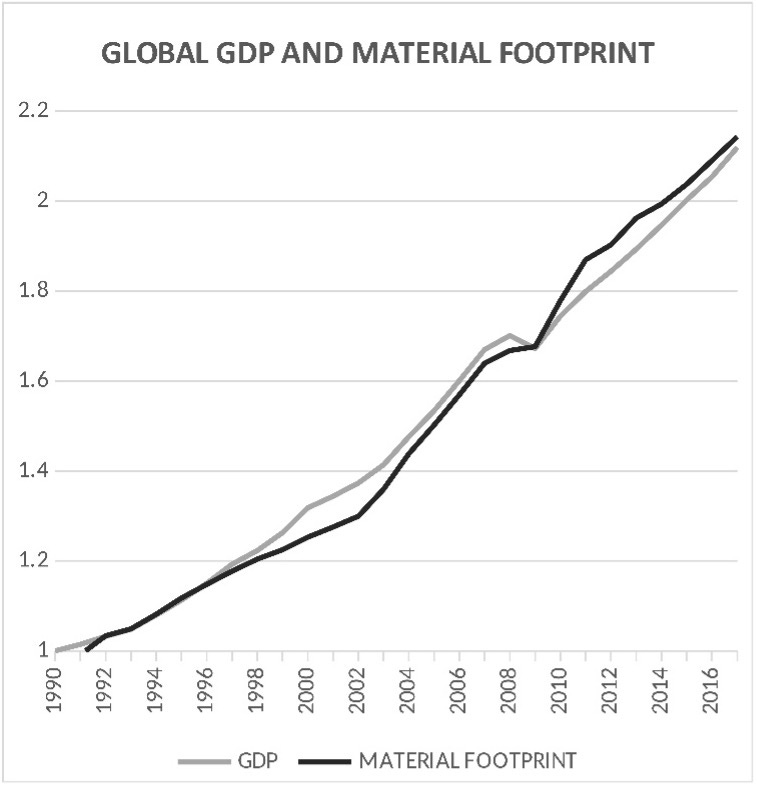
Source: Jason Hickel, and Giorgos Kallis, “Is Green Growth Possible?”, New Political Economy 25, no. 4 (2019): 469–86
When scientists from the UN’s Intergovernmental Panel on Climate Change (IPCC) deliver scenarios for global heating this century, it’s natural to believe that they use serious, grounded assumptions in their models. However, closer analysis reveals that the scenario where we stay under 2°C of global heating involves an extravagant assumption that we will suck 730 billion metric tonnes of carbon out of the atmosphere this century—an amount equivalent to roughly twenty times the total current annual emissions from all fossil fuel usage, using speculative technologies that are unproven at scale. Such an assumption is closer to science fiction than the rigorous analysis worthy of a model on which our civilization is basing its future.
Yet, even as the IPCC appears willing to model humanity’s fate on a pipe dream, not one of their scenarios explores what is possible from a graduated annual reduction in global GDP. Such a scenario was considered by the IPCC community to be too implausible to consider.
What Systemic Change Actually Requires
The Doomsday Clock stands at 85 seconds to midnight — the closest to catastrophe in its history. Scientists, UN secretaries-general, and climate researchers are all pointing in the same direction. And yet, like a crowd dancing together following the Pied Piper off the cliff, our civilization continues its trajectory — each institution assuming the path must be navigable because so many others are taking it.
What would it mean to actually change course?
A civilization built on a different foundation would start from an acknowledgment that the deep interconnectedness of all life is not romantic aspiration but scientific fact — confirmed by complexity science, systems biology, and Earth science, and affirmed by wisdom traditions of cultures that never lost that understanding. From this recognition, different goals follow: not perpetual growth but setting the conditions for all people to flourish on a regenerated Earth. Not maximization of returns on capital but the kind of reciprocal, mutualistic relationship with living systems that makes long-term human wellbeing possible.
There is no blueprint that will save us. No one person or group can design in advance what such a civilization will look like in its particulars. But a framework of core principles can orient us — the way a distant horizon orients a traveler moving through unmarked terrain. You may not yet see the exact path, but knowing the general direction changes everything about which opportunities you embrace and which you recognize as alluring detours.
The trance that keeps us from seeing this is powerful. But it has been broken before. Every paradigm that once seemed like reality itself — the divine right of kings, the natural inferiority of women, the Earth at the center of the universe — turned out to be a myth that was shattered. The story of TINA — There Is No Alternative — is the defining myth of our moment. The first act of system change is to stop believing it.
Ecocivilization: Making a World that Works for All
Melville House: available May 26, 2026
PREORDER: Bookshop.org | Amazon US | Amazon UK

Read more about Ecocivilization
Jeremy Lent, is an author and speaker whose work investigates the underlying causes of our civilization’s existential crisis, and explores pathways toward a life-affirming future. He is founder of the Deep Transformation Network and co-founder of the Ecocivilization Coalition. His previous two books were The Web of Meaning and The Patterning Instinct.
Wonderful message Jeremy. Love your books. We also need a new global myth. A religious uniting concept that will bring us in the future.
Incorporate religions to a broader planetary concept of a religion for the earth a cosmic evolution. A religion for all life on the planet. Dogmas dont matter, only peace, love and compassion
That is a very powerful metaphor, and quite apropos. It reminds me of another appearance of it. Arran Gare, author of The Philosophical Foundations of Ecological Civilization (2018) had earlier referenced this image in one of his review articles: "... we can now see that this nihilistic conclusion is not the wisdom of people with superior intelligence. It is the mindless drifting among fragments combined with shallow optimism of people with malfunctioning brains. And where will it lead us? McGilchrist concluded '... expect a sort of insouciant optimism, the sleepwalker whistling a happy tune as he ambles towards the abyss.'
Source: Gare, A. (2012). ’The Master and His Emissary: The Divided Brain and the Western World’ by Iain McGilchrist. Cosmos and History: The Journal of Natural and Social Philosophy, 8(1), 412–449. https://cosmosandhistory.org/index.php/journal/article/view/290